Thursday, 28 November 2019

EDUCATION FOR SUSTAINABLE DEVELOPMENT


 Education for Sustainable Development 

Courtesy: 

"Education for Sustainable Development allows every human being to acquire the knowledge, skills, attitudes and values necessary to shape a sustainable future.


Education for Sustainable Development means including key sustainable development issues into teaching and learning; for example, climate change, disaster risk reduction, biodiversity, poverty reduction, and sustainable consumption.

It also requires participatory teaching and learning methods that motivate and empower learners to change their behaviour and take action for sustainable development. Education for Sustainable Development consequently promotes competencies like critical thinking, imagining future scenarios and making decisions in a collaborative way.

Education for Sustainable Development requires far-reaching changes in the way education is often practised today."
Council of the European Union, 2010
"ESD is essential for the achievement of a sustainable society and is therefore desirable at all levels of formal education and training, as well as in non-formal and informal learning."  
Sustainable Development Education Panel Report, 1998
"ESD is about the learning needed to maintain and improve our quality of life and the quality of life of generations to come ... ESD enables people to develop the knowledge, values and skills to participate in decisions about the way we do things individually and collectively, both locally and globally, that will improve the quality of life now without damaging the planet for the future."


Sustainability in the curriculum

At Plymouth, we take the approach that there is no definitive knowledge content that should be included in a curriculum addressing sustainability or sustainable development. Rather, following Tilbury & Wortman (2004), we point to indicative curricular themes that may be more or less relevant to each disciplinary area and which might be used and adapted as ‘entry points’ to develop sustainability education further. 
Environmental sustainabilityEconomic sustainabilitySocial sustainability
Natural resources managementAlternative futuresSustainable communities
Food and farmingLeadership and changeCultural diversity
Ecological systemsLearning organisationsIntercultural understanding
Waste / water / energyCorporate Social ResponsibilitySustainability in the built environment
BiodiversityConsumerism and tradeTravel, transport and mobility
Climate changeGlobalisation of economyHealth and wellbeing
Accountability and ethicsPeace, security and conflict
International developmentCitizenship, government, democracy
Sustainable and ethical tourismHuman rights and needs
Population

Pedagogical approaches in ESD

There is no ‘correct’ pedagogy for sustainability education, but there is a broad consensus that it requires a shift towards active, participative, and experiential learning methods that engage the learner and make a real difference to their understanding, thinking and ability to act.
We've identified five pedagogic elements that cover a host of pedagogical approaches or methods that staff at Plymouth might use to bring these elements into the learning environment. 
1. Critical reflection – including the more traditional lecture, but also newer approaches such as reflexive accounts, learning journals, and discussion groups.
2. Systemic thinking and analysis – the use of real-world case studies and critical incidents, project-based learning, stimulus activities, and the use of the campus as a learning resource.
3. Participatory learning – with emphasis on group or peer learning, developing dialogue, experiential learning, action research/learning to act, and developing case studies with local community groups and business
4. Thinking creatively for future scenarios – by using role play, real-world inquiry, futures visioning, problem-based learning, and providing space for emergence.
5. Collaborative learning – including contributions from guest speakers, work-based learning, interdisciplinary/ multidisciplinary working, and collaborative learning and co-inquiry.

Further reading:\
https://www.greenofficemovement.org/education-for-sustainable-development/

https://en.unesco.org/themes/education-sustainable-development

Wednesday, 14 August 2019

MAJOR ROLES OF HEADMASTER

Major Roles of a Headmaster

Courtesy:

Brief outlines of the seven major roles of headmaster are discussed in this article. The roles are (1) Role in Planning (2) Role in School Organisation (3) Teaching Role (4) Role in Supervision (5) Role in Guidance (6) Role in Maintaining Relations (7) Role in General Administration.

1. Role in Planning:

Planning is the first and foremost duty of the head of a school. He has to plan a number of things in the school with the co-operation of the teachers, the pupils, the parents and general public. Planning goes on throughout the year.
It consists of the following phases:
(i) Planning before the opening of the school:
The headmaster has to plan a number of things in the school. He will chalk out the policies and rules of admission. Dates of admission are to be publicized. He should convene the meetings of the staff and discuss with the teachers their activities and programmes for the whole year. Thus the school calendar may be prepared in advance. In case of need fresh staff will be recruited before the actual functioning of the school. The headmaster must also check that whole school plant is in proper shape and the equipment is adequate. He must also see that various registers needed for different purposes are there in the school.
(ii) Planning during the First Week:
In the beginning, the headmaster has to set the school machinery into motion. Work allotment to the teachers is an important function of the headmaster. He should urge the teachers to balance class-sizes and classify students into suitable groups or sections. Preparation of time table general, teacher wise and class wise is another important thing to be done. Unless the time-table is prepared, school work cannot be started. General assembly of the students may be convened and instructions be given to the students. The prescribed text-books are to be announced.
(iii) Planning During the Year:
As the classes start, the headmaster starts attending to each activity to be done. The headmaster has to prepare the budget of the year keeping in view the estimated expenditure in the session.
(iv) Planning at the End of the Year:
The headmaster will ask the teachers to prepare reports of the activities done during the year. Various records have to be completed. Holding of valedictory and annual function has to be planned.
ADVERTISEMENTS:
(v) Planning of the Next Year:
The headmaster should convene staff meetings and appraise year’s work. In the light of this appraisal, next year’s work has to be planned.

2. Role in School Organisation:

The headmaster is not to plan things theoretically, but to give them a practical shape.
In this regard, he must organize the following items:
(i) Organizing instructional work:
The head of a school must organize the instructional work. He will ask the teacher to divide the year’s work into smaller units. This will also involve the formulation of objectives, selection of methods of teaching, classification of pupils, framing of time-table etc.
(ii) Organizing Co-Curricular Activities:
The headmaster must organize the activities of the school with the co-operation of staff and students. There are so many school activities like sports, scouting, girl-guiding, red-cross, parent-teacher association, celebration of religious and social functions and festivals etc.
(iii) Organizing the School Plant:
The headmaster is to organize the school plant so that it will be properly maintained, equipped and put to maximum use. Classroom library, laboratory is to be well furnished. Repairing may be done wherever needed.
(iv) Organizing School Office:
The office work must also be properly organised. Routine work, registration, correspondence, maintenance of accounts etc. have to be organised so that office work will be done regularly and efficiently.

3. Teaching Role:

The headmaster must share instructional work with the teachers. He should consider himself teacher first and last. His teaching should be exemplary. This way he keeps in touch with the work of the teachers and the achievements of students. The headmaster should understand the problems of the teachers and the pupils better when he himself teaches.

4. Role in Supervision:

The head of a school should not simply sit in his office. He should supervise the work of the school here, there and every where. He should supervise instructional work. He may have a round of the class-rooms. However, it is not to be a fault finding business.
The headmaster should supervise the activities going on in the playground, hall, art room, library, workshop etc. He must supervise the proper use and keep up of school materials. In general, he should supervise the behaviour of students, provide facilities for them to maintain cleanliness of the campus etc.

5. Role in Guidance:

The headmaster is not simply a fault finder. Wherever he finds defects, errors and inefficiency he should show the correct path to the students. He must guide the teachers in the methods of teaching and organisation of activities. Besides students are to be guided by him in matters of study, activities and personal difficulties. A guidance cell may be organised in the school. Besides, the headmaster has to guide parents and higher authorities etc.

6. Role in Maintaining Relations:

The reputation of the headmaster and of the school mostly depends upon the relations that he maintains with the staff, students and their parents and the community.
(i) Relations with the Staff:
The head of a school must work in a team spirit and he should regard the teacher as his co-workers. He should not have bossing tendency. He must give due regard to the teachers, their views and their problems.
(ii) Relations with the Pupils:
“Great headmasters have been great friends of pupils.” The headmaster should think that the teachers, the school and he himself all are meant for the pupils. He must listen to their genuine difficulties and try to remove the same. He must provide proper facilities for their learning.
(iii) Relations with the Parents:
The headmaster must maintain link of the parents with the school. They may be invited to the school on important occasions. He should organize parent teacher organisation in the school. When the parents come to school they should be treated with courtesy and be given due respect.
(iv) Relation with the Community:
The school is meant for the community and must be made a community centre. A number of community activities may be launched by the headmaster on behalf of the school. Community members may also be invited to the school on certain occasions.

7. Role in General Administration:

As the head of the school, the headmaster is responsible for all that is being done in or by the school. He is to issue necessary orders and get their compliance. He must see that the teachers and the pupils attend their duties punctually and regularly. He must ensure that human and material resources of the school are adequate. Purchases should be made wherever needed in accordance with the prescribed official information and correspondence

Wednesday, 20 March 2019

INSTITUTIONAL PLANNING

Institutional Planning

Image result for Institutional Planning


According to Prof. M.B.Buch (1968) an institutional plan is a programme of development by an educational institution on the basis of its felt needs and the resource available or likely to be available with a view to improving the school programme and school practices. It is based in the principal of optimum utilization of the resources available in the school and the community. The plan may be for a longer duration or a shorter duration.

Objectives of institutional planning

• To bring improvement in the structure of educational institution
• To give proper direction to functioning of educational institutions
• To develop a comprehensive programme of improvement of educational system in all its parameters by optimum utilization of existing resources within its reach
• To provide opportunities to the members of the local community, staff and students to treat educational institutions as a joint and coo operative venture and to bring improvement in education institutions
• To give adequate freedom to teachers think to innovative and creative ideas for the improvement of institution and other programmes in the institution.
• To impart realism and concreteness to educational planning
• To shift the emphasis from expenditure orientation to the effort orientation and proper utilization of the resources. i
• To create democratic environment to enable every teacher, administrator, parent and students to take part in the formulation and implementation of the plan.

Nature and characteristics of an institutional plan

1. need based
2. specificity
3. optimum utilization
4. augmentating Human efforts
5. goal – oriented
6. cooperative in nature
7. long and short term plans
8. flexibility

NEED AND IMPORTANCE OF INSTITUTIONAL PLANNING

1. FOR BETTERMENT AND IMPROVEMENT

All institutions have some plans. All the heads of institutions make plans and each teacher also plans. In fact each headmaster and teacher does plan but this planning my not be systematic adequate and clear. This planning may not exist in a definite or regular form. Planning may mostly be routine planning of the syllabus time table and examination etc. and it may not exist in a definite or regular form and it may be repeated from term to term and from session to session without much thinking.

2. TO GIVE PROPER DIRECTION TO EDUCATIONAL OBJECTIVES

Institutional planning will gives you right direction to the educational planning in the country i.e, the upward direction from bottom to top. In the normal trend followed today the direction of planning is from top to bottom. Institutional planning is the recognition of the role of administrators‟ teachers, parents, students, educationists and social reformers in the process of planning of education in the country.

3. FOR MAXIMUM UTILIZATION OF RESOURCES

Institutional planning leads to optimum use of the existing resources. As a nation we face a great scarcity of resources with increasing needs and demands from every quarter. Therefore we must plan for maximum utilization of scarce resource.

4. FOR NATIONAL DEVELOPMENT

Educational planning must fit into the over all national planning for developmental purposes. As such it gets importance from the need for collective efforts of the people. In the words of B.D. Nag Chaudhari, Since the implementation of plan‟s and programmes is as important and vital as plan formulation. Institutional planning has a special contribution to make in national development.

5. TO ENCOURAGE INITIATIVE OF INDIVIDUAL TEACHER

Institutional plan encourages initiative freedom and creativity of the teacher makes the individual teacher effective. It motivates them too strive harder for achieving excellence. It draws out the best of the teachers.

6. FOR DEMOCRATIZATION OF PLANNING

Institutional planning democratizes the process of planning because it takes into
confidence the students the teachers the parents and the head of the institution. Sh.J.P.Naik says, “A major reform, I propose, therefore is that the planning that resembles an inverted pyramid should be broad-based and decentralized by introducing the system of institutional plans.” He strongly planed to have a fine blend of the centralized and decentralized systems of educational planning in our country.

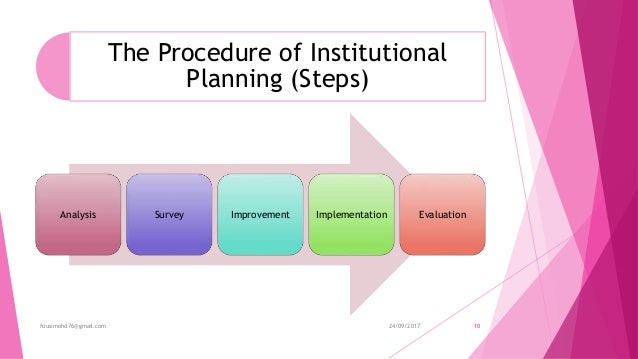
STEPS OF INSTITUTIONAL PLANNING

1. Survey of the needs of an institution
2. survey of resources
3. determining priorities and formulation of action plan
4. execution of the plan
5. evaluation of the plan

INSTITUTIONAL PLANNING—Steps

1. ANALYSIS: Analysis of the Institution‘s present situation in terms of needs is carried out. This analysis involves:

i. School building in terms of space.
ii. Equipment and furniture are adequate.
iii. Laboratory and library equipment.
iv. Programmes which require change.
v. Staff requirements.
vi. Additional infrastructure like hostel, staff quarters, school bus, play-grounds etc.
vii. Examination system.
vii. Admission procedures.
ix. Identification of areas which require improvement, but can be done without additional resources is also analysed.

2. SURVEY: Based on the Analysis carried out, a Survey of the existing resources as well those available in the future is to be carried out. The survey must include Statistical fact and figures regarding;

1. Enrolment.
2. Staff.
3. Equipment.
4. Books.
5. Examination results.
The resources to be surveyed fall into the following categories;
a. Resources in the School. b. Resources available through the Government.
c. Resources available in the Community

3. IMPROVEMENT: Every institution must prepare a List of Improvement programmes, along with details of each programme. The programmes can be Long term or short term in nature. Each improvement programme must be specific in terms of;

i. Utility for the institution.
ii. Financial implications.
iii. Objectives must be stated in clear terms.
iv. The programmes must be clearly outlined in terms of tasks.

Each task must be specified in terms of:
i. Resources required
ii. Time schedule for each task.
iii. Expected output.

4. IMPLEMENTATION: Implementation of the Improvement programmes should follow the given guidelines;
• Available material and human resources should be utilised.
• There should be cooperation among all staff members.
• The principal would be overall in-charge and certain staff members would be
responsible for a project.
• There should be division of tasks amongst all members involved in a project.
• Commitees may be appointed to ensure smooth execution of the programmes.
• A time schedule should be prepared for the project, specifying amount of work to be done in each time period.

5. EVALUATION: At the end of implementation of an Improvement programme, it must be assessed Qualitatively and quantitatively.
• The evaluation must check whether the pre-planned objectives have been fulfilled to what extent.
• Necessary feedback must be obtained from all stakeholders and beneficiaries of the programme.
• Financial status and cost should be measured in terms of the output achieved.

Benefits of an institutional planning

- it involves the teachers the process of planning thereby making planning more
democratic in nature
- the preparation of the plan adopts the down to top approach where first hand
knowledge about the strengths , weakness and the problems arising in the classroom processes and situations is available from teachers
- it is more realistic because I it is based on the data available from then stakeholders namely students a, teachers and parents
- it avoids wastage as it is founded on knowledge about real needs of the students and the community
- it is more scientific , rational , effective and efficient rather than trial and error methods or traditional approach development.
- Each institution has a unique personality or climate and the plan prepared in the light of this climate will be more realistic and effective
- it is goal based and there fire is more efficient
- involving teachers in the process of planning motivates them , channelizes their energies towards achieving the goals , arouses enthusiasm in them , making its implementation easier
- it reduced emphasis on expenditure orientation and enhances goal orientation
- it provides ample opportunities fro creativity, innovations, initiative , freedom and experimentation to those who are involved in preparing and implementing the plans


For further reading: 

Tuesday, 19 June 2018

ROLES OF A TEACHER IN THE 21ST CENTURY

ROLES OF A TEACHER IN THE 21ST CENTURY


Teacher Training
Teacher Roles:
1. The Controller: The teacher is in complete charge of the class, what students do, what they say and how they say it. The teacher assumes this role when a new language is being introduced and accurate reproduction and drilling techniques are needed.
In this classroom, the teacher is mostly the center of focus, the teacher may have the gift of instruction, and can inspire through their own knowledge and expertise, but, does this role really allow for enough student talk time? Is it really enjoyable for the learners? There is also a perception that this role could have a lack of variety in its activities.
2. The Prompter: The teacher encourages students to participate and makes suggestions about how students may proceed in an activity. The teacher should be helping students only when necessary.
When learners are literally ‘lost for words’, the prompter can encourage by discreetly nudging students. Students can sometimes lose the thread or become unsure how to proceed; the prompter in this regard can prompt but always in a supportive way.
3. The Resource: The teacher is a kind of walking resource center ready to offer help if needed, or provide learners with whatever language they lack when performing communicative activities. The teacher must make her/himself available so that learners can consult her/him when (and only when) it is absolutely necessary.
As a resource the teacher can guide learners to use available resources such as the internet, for themselves, it certainly isn’t necessary to spoon-feed learners, as this might have the downside of making learners reliant on the teacher.
4. The Assessor: The teacher assumes this role to see how well students are performing or how well they performed. Feedback and correction are organized and carried out.
There are a variety of ways we can grade learners, the role of an assessor gives teachers an opportunity to correct learners. However, if it is not communicated with sensitivity and support it could prove counter-productive to a student’s self-esteem and confidence in learning the target language.
5. The Organizer: Perhaps the most difficult and important role the teacher has to play. The success of many activities depends on good organization and on the students knowing exactly what they are to do next. Giving instructions is vital in this role as well as setting up activities.
The organizer can also serve as a demonstrator, this role also allows a teacher to get involved and engaged with learners. The teacher also serves to open and neatly close activities and also give content feedback.
6. The Participant: This role improves the atmosphere in the class when the teacher takes part in an activity. However, the teacher takes a risk of dominating the activity when performing it.
Here the teacher can enliven a class; if a teacher is able to stand back and not become the center of attention, it can be a great way to interact with learners without being too overpowering.
7. The Tutor: The teacher acts as a coach when students are involved in project work or self-study. The teacher provides advice and guidance and helps students clarify ideas and limit tasks.
This role can be a great way to pay individual attention to a student. It can also allow a teacher to tailor make a course to fit specific student needs. However, it can also lead to a student becoming too dependent or even too comfortable with one teacher and one method or style of teaching.
 For further reference:

Thursday, 1 February 2018

IMPORTANCE OF SCIENCE IN SCHOOL CURRICULUM


Importance of science in School Curriculum


Science is one of those human activities that man has created to gratify certain human needs and desires. Disinterested curiosity has been the greatest motive power of scientific research. The ‘search of truth’ became the dominant motive in the prosecution of science. It has been pursued for so many centuries and attracted ever- wider extent of attention of a much persisted group of people. Science is valued mostly for its practical advantages though it is also valued of gratifying disinterested curiosity and as an object of great aesthetic charm. It is quite obvious that the bulk of mankind, value science, chiefly for the practical advantages it brings with it.
According to Montessori Teacher Training, a few decades back, science was given a step- motherly treatment and was considered to be a subject meant for less promising students, the more promising student were encouraged to study the classics and mathematics as being more worthy and suitable subjects. Since has now established its claim to be placed in the school curriculum. It has now been recognized as a compulsory subject right from the elementary stage and now one of the core subjects at higher secondary stage. It has taken a good many years of active and persistent effort to reach this position.
It will be futile to prepare separate case for the inclusion of science in the curriculum because the reasons for its inclusions are exactly the same as those for the inclusions of science in the curriculum because of some special values provided by science only and not by any other subject. All the school subjects are taught because they provide a liberal education, they are a part of equipment and preparation for life which we expect the school to give to its pupil so that they may play their part in community as intellectual citizens. Science takes its place side by side with other subjects as an essential element of one’s education. It affords a knowledge of certain facts and laws and an insight into methods and data peculiar to the domain of science. However the inclusion of any subject in the curriculum should satisfy the intellectual, utilitarian, vocational, cultural, moral and aesthetic values. Besides these the teaching of science imparts training in the ‘scientific method’ and develops ‘scientific attitude’ which are very valuable and at the same time are transferable to other situations in life.
The rapid advancement of science and technology and increasing need for scientists and technologists have made it all the more important to provide for science based educations in the schools. Vigorous methods for the cultivation and promotion of science should be adopted. The Teacher Training Mumbai has recommended that every secondary school pupil should study general science as a compulsory subject so that he gains a basic quantum of scientific knowledge as a part of his general education. In addition provision should be made for providing elective subjects in science for those students who want to pursue higher study.

EDUCATIONAL WEBSITES

EDUCATIONAL WEBSITES Courtesy:  https://www.indiatoday.in/education-today/featurephilia/story/free-education-953499-2017-01-06 Eve...