Saturday, 2 December 2017

WEEKLY REFLECTION FROM 27/11/2017 TO 01/12/2017

Dominus Mea Illuminatio
MAR THEOPHILUS TRAINING COLLEGE
Mar Ivanios Vidya Nagar, Nalanchira, Thiruvananthapuram- 695015
Affiliated to University of Kerala, Recognized by NCTE
 Re-Accredited by NAAC with ‘Grade A’
General Proforma for Weekly Up-loading in Personal Blogs
During B.Ed. Internship Phase II (2017)

Ø School:
St.Johns. H.S.S, Nalanchira, Trivandrum
Ø Dates of Practice:
From  27/11/2017  To 01/12/2017
Ø Coverage of Curricular Components:
I completed 5 lesson plans for both 8th & 9th standard
(For 8th –Modern trends in taxonomy, classification of Virus; 9th-   kidney in homeostasis, kidney diseases & Urine formation)
Ø Participation/ Leadership in Co-Scholastic Activities:
Lead the students for Christmas carol song practice. Helped students for preparing for School kalotsavam .
Ø Progress of other practical during the week:
Completed introduction and review of the project and uploaded more topics on already prepared website.

Ø Special Responsibilities undertaken: Took classes for weaker students, Helped in serving food on lunch time.

Ø Difficulties Faces/ How you managed the situation?: Nil

Ø Areas that require further improvement:

Need to collect more moral stories and interesting general facts for handling students in extra hours.


Ø Self Reflection and Rating:  I am so happy in completing the first phase of my project and could prepare well for taking classes with ICT , charts and activities.

Thursday, 30 November 2017

DECEMBER 01-WORLD AIDS DAY

Image result for aids day 2017 theme

Learning Disabilities

Types of Learning Disabilities

Student reading a book in classromLearning disabilities are neurologically-based processing problems. These processing problems can interfere with learning basic skills such as reading, writing and/or math.  They can also interfere with higher level skills such as organization, time planning, abstract reasoning, long or short term memory and attention.  It is important to realize that learning disabilities can affect an individual’s life beyond academics and can impact relationships with family, friends and in the workplace.
Since difficulties with reading, writing and/or math are recognizable problems during the school years, the signs and symptoms of learning disabilities are most often diagnosed during that time.  However, some individuals do not receive an evaluation until they are in post-secondary education or adults in the workforce.  Other individuals with learning disabilities may never receive an evaluation and go through life, never knowing why they have difficulties with academics and why they may be having problems in their jobs or in relationships with family and friends.
Learning disabilities should not be confused with learning problems which are primarily the result of visual, hearing, or motor handicaps; of mental retardation; of emotional disturbance; or of environmental, cultural or economic disadvantages.
Generally speaking, people with learning disabilities are of average or above average intelligence. There often appears to be a gap between the individual’s potential and actual achievement. This is why learning disabilities are referred to as “hidden disabilities”: the person looks perfectly “normal” and seems to be a very bright and intelligent person, yet may be unable to demonstrate the skill level expected from someone of a similar age.
A learning disability cannot be cured or fixed; it is a lifelong challenge. However, with appropriate support and intervention, people with learning disabilities can achieve success in school, at work, in relationships, and in the community.
In Federal law, under the Individuals with Disabilities Education Act (IDEA), the term is “specific learning disability,” one of 13 categories of disability under that law.
“Learning Disabilities” is an “umbrella” term describing a number of other, more specific learning disabilities, such as dyslexia and dysgraphia. Find the signs and symptoms of each, plus strategies to help below.

Specific Learning Disabilities
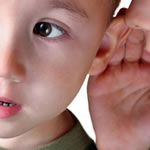
Young boy listening to a friend talking into his hear, demonstrating symptoms of Auditory Processing Disorder.Auditory Processing Disorder (APD)

Also known as Central Auditory Processing Disorder, this is a condition that adversely affects how sound that travels unimpeded through the ear is processed or interpreted by the brain. Individuals with APD do not recognize subtle differences between sounds in words, even when the sounds are loud and clear enough to be heard. They can also find it difficult to tell where sounds are coming from, to make sense of the order of sounds, or to block out competing background noises.
Young femaile student having difficulty with math problem on chalkboard displaying symptoms of Dyscalculia.

Dyscalculia

A specific learning disability that affects a person’s ability to understand numbers and learn math facts. Individuals with this type of LD may also have poor comprehension of math symbols, may struggle with memorizing and organizing numbers, have difficulty telling time, or have trouble with counting.

Student having difficulty writing while doing school work, expressing symptoms of Dysgraphia.Dysgraphia

A specific learning disability that affects a person’s handwriting ability and fine motor skills. Problems may include illegible handwriting, inconsistent spacing, poor spatial planning on paper, poor spelling, and difficulty composing writing as well as thinking and writing at the same time.

Young female student expressing frustration while rereading, demonstrating symptoms of Dyslexia.Dyslexia

A specific learning disability that affects reading and related language-based processing skills. The severity can differ in each individual but can affect reading fluency, decoding, reading comprehension, recall, writing, spelling, and sometimes speech and can exist along with other related disorders. Dyslexia is sometimes referred to as a Language-Based Learning Disability.

Little girl holding up toy blocks that spell "LEARN".Language Processing Disorder

A specific type of Auditory Processing Disorder (APD) in which there is difficulty attaching meaning to sound groups that form words, sentences and stories. While an APD affects the interpretation of all sounds coming into the brain, a Language Processing Disorder (LPD) relates only to the processing of language. LPD can affect expressive language and/or receptive language

Young boy sitting alone holding his kneesNon-Verbal Learning Disabilities

A disorder which is usually characterized by a significant discrepancy between higher verbal skills and weaker motor, visual-spatial and social skills. Typically, an individual with NLD (or NVLD) has trouble interpreting nonverbal cues like facial expressions or body language, and may have poor coordination.

 

Young girl having difficulty painting displaying symptoms of Visual Perception/Visual Motor Deficit disorder.Visual Perceptual/Visual Motor Deficit

A disorder that affects the understanding of information that a person sees, or the ability to draw or copy. A characteristic seen in people with learning disabilities such as Dysgraphia or Non-verbal LD, it can result in missing subtle differences in shapes or printed letters, losing place frequently, struggles with cutting, holding pencil too tightly, or poor eye/hand coordination.

Related Disorders

Distracted teenage student looking out of classroom window during school displaying symptoms of ADHD.ADHD

A disorder that includes difficulty staying focused and paying attention, difficulty controlling behavior and hyperactivity. Although ADHD is not considered a learning disability, research indicates that from 30-50 percent of children with ADHD also have a specific learning disability, and that the two conditions can interact to make learning extremely challenging.

Young child playing in children's ball pit.Dyspraxia

A disorder that is characterized by difficulty in muscle control, which causes problems with movement and coordination, language and speech, and can affect learning. Although not a learning disability, dyspraxia often exists along with dyslexia, dyscalculia or ADHD.

Executive FunctioningYoung adult woman writing in her organizer

An inefficiency in the cognitive management systems of the brain that affects a variety of neuropsychological processes such as planning, organization, strategizing, paying attention to and remembering details, and managing time and space. Although not a learning disability, different patterns of weakness in executive functioning are almost always seen in the learning profiles of individuals who have specific learning disabilities or ADHD.

Young man with string tied to finger trying to remember something.Memory

Three types of memory are important to learning. Working memory, short-term memory and long-term memory are used in the processing of both verbal and non-verbal information. If there are deficits in any or all of these types of memory, the ability to store and retrieve information required to carry out tasks can be impaired.

Courtesy: https://ldaamerica.org/types-of-learning-disabilities/
 

Sunday, 26 November 2017

WEEKLY REFLECTION 20/11/2017 TO 24/11/2017

Dominus Mea Illuminatio
MAR THEOPHILUS TRAINING COLLEGE
Mar Ivanios Vidya Nagar, Nalanchira, Thiruvananthapuram- 695015
Affiliated to University of Kerala, Recognized by NCTE
 Re-Accredited by NAAC with ‘Grade A’
General Proforma for Weekly Up-loading in Personal Blogs
During B.Ed. Internship Phase II (2017)

Ø School:
St.Johns. H.S.S, Nalanchira, Trivandrum
Ø Dates of Practice:
From  20/11/2017  To 24/11/2017
Ø Coverage of Curricular Components:
I completed 6 lesson plans for both 8th & 9th standard
(For 8th –History of taxonomy, 5 and 6 kingdom classification; 9th-   Nephron, Longitudinal section of kidney, Urine formation)
Ø Participation/ Leadership in Co-Scholastic Activities:
Lead the students for eye checking and vaccination camps. Helped students for organizing school assembly, Give guidelines to conduct exhibition for higher secondary students.
Ø Progress of other practical during the week:
Prepared a test run website for the project. Made innovative charts and cards for making teaching-learning process more effective.

Ø Special Responsibilities undertaken: 
Took classes for weaker students, Helped in serving food on lunch time.

Ø Difficulties Faces/ How you managed the situation?: Nil

Ø Areas that require further improvement:

Need to make more innovative models on dry topics.


Ø Self Reflection and Rating:  
      I really happy in improving my talents and ideas on making models and charts. I prepared each lesson plan with different ideas. I got opportunity to take more free class and gave moral values to students for enhancing their life. I became more confident in my teaching style and delivery of content.

Wednesday, 22 November 2017

Teaching Techniques You Should Know!

Teaching Techniques You Should Know!

Education, like almost every other area of our society, has evolved in leaps and bounds in recent years. Traditional teaching techniques, based mainly on a teacher explaining a topic and students taking notes,may still be useful on occasion, but education today revolves more around encouraging the student to awaken their curiosity and desire to learn.
A number of different teaching techniques have emerged due to this change in education. Many of these teaching techniques are not actually new however! The use of technology in the classroom has simply given education a new lease of life allowing us to approach old ideas in new ways.
Outlined below are some popular teaching techniques that have arisen from the integration of technology in education.

1. Flipped Classroom (Inverting your class):

The Flipped Classroom Model basically involves encouraging students to prepare for the lesson before class. Thus, the class becomes a dynamic environment in which students elaborate on what they have already studied. Students prepare a topic at home so that the class the next day can be devoted to answering any questions they have about the topic. This allows students to go beyond their normal boundaries and explore their natural curiosity.

2. Design Thinking (Case Method):

This technique is based on resolving real-life cases through group analysis, brainstorming, innovation and creative ideas. Although “Design Thinking” is a structured method, in practice it can be quite messy as some cases may have no possible solution.However, the Case Method prepares students for the real world and arouses their curiosity, analytical skills and creativity. 

3. Self-learning:

Curiosity is the main driver of learning. As a basic principle of learning, it makes little sense to force students to memorize large reams of text that they will either begrudgingly recall or instantly forget. The key is to let students focus on exploring an area which interests them and learn about it for themselves.
4. Gamification:
teaching techniquesLearning through the use of games is one of the teaching methods that has already been explored especially in elementary and preschool education. By using games, students learn without even realizing. Therefore, learning through play or ‘Gamification‘ is a learning technique that can be very effective at any age. It is also a very useful technique to keep students motivated.

The teacher should design projects that are appropriate for their students, taking into account their age and knowledge, while making them attractive enough to provide extra motivation. One idea may be to encourage students to create quizzes online on a certain topic. Students can challenge their peers to test themselves and see who gets a higher score. In this way, students can enjoy the competition with peers while also having fun and learning.

5. Social Media:

 A variant of the previous section is to utilize social media in the classroom. Students today are always connected to their social network and so will need little motivation to get them engaged with social media in the classroom. The ways you can use teaching methods are quite varied as there are hundreds of social networks and possibilities.

6. Free Online Learning Tools:

There is an array of free online learning tools available which teachers can use to encourage engagement, participation and a sense of fun into the classroom. Teachers can create an interactive and dynamic classroom environment using, for example, online quizzes to test student’s knowledge.
COURTESY: https://www.goconqr.com/en/examtime/blog/teaching-techniques/

EDUCATIONAL WEBSITES

EDUCATIONAL WEBSITES Courtesy:  https://www.indiatoday.in/education-today/featurephilia/story/free-education-953499-2017-01-06 Eve...